What protocols check before deploying on your chain
See why Maple and Steakhouse deployed Safe before Robinhood Chain launched. Even Vitalik Buterin keeps 90% of his crypto in a Safe multisig.
Aniket Bhardwaj at Safe{Labs} • 27 July 2026
)
Each new chain believes its technology will drive adoption: faster transactions, higher throughput, lower gas fees. It rarely does, at least not alone. What attracts builders is working infrastructure they already trust.
In almost every conversation we have with DeFi protocols, foundations, treasury operators, and RWA issuers evaluating a new network, one question comes up almost immediately:
"Is Safe multisig deployed?"
Our hypothesis at Safe Labs is simple: Safe is what lets a chain bootstrap onchain finance, whether that's DeFi, trading, lending, or tokenized assets.
Without Safe, a chain struggles to attract total value locked (TVL), onboard liquidity providers, or win high-quality protocols. Every serious amount of money moving onchain runs through multisigs, and Safe is the multisig standard across EVM-compatible chains.
What is Safe?
Today, Safe secures more than $60B in onchain assets across more than 35 networks, has processed more than 750M transactions. Safe is also the tool teams operate through: deploying contracts, pushing upgrades, and executing privileged functions like mint, redeem, or freeze. Multiple signers approve every action instead of one private key.
What Safe deployment gives a chain on day one
The obvious part: dapps can deploy their contracts. Their admin keys and treasuries already sit in Safes on every chain they operate on, and Safe's deterministic deployment lets them recreate the same multisig at the same address on your chain in minutes.
Less obvious, and just as important:
Your foundation gets a treasury it can actually run: OTC trades, paying out or receiving grants, payroll, DeFi positions, all with role-based access and spending limits instead of a spreadsheet of hardware wallets.
Liquidity providers and whales bridge in sooner, because the wallet holding their portfolio on 35+ other chains works on yours from day one.
And builders get the full multisig tooling to deploy and upgrade their contracts: the Safe{Wallet} UI, Transaction Service, and Transaction Builder, ready before your first dapp ships.
What happened on Robinhood Chain
When Robinhood Chain went public on 1 July 2026, positioning itself as a blockchain built for financial services and tokenized real-world assets, Safe{Wallet} was already live.
Protocols made sure of that. During testnet, teams preparing their deployments asked us to ship Safe before the network's public launch. Uniswap, Maple, 0x, Morpho, and Steakhouse Finance all needed a multisig in place before they could deploy vaults, smart contracts, and admin roles.
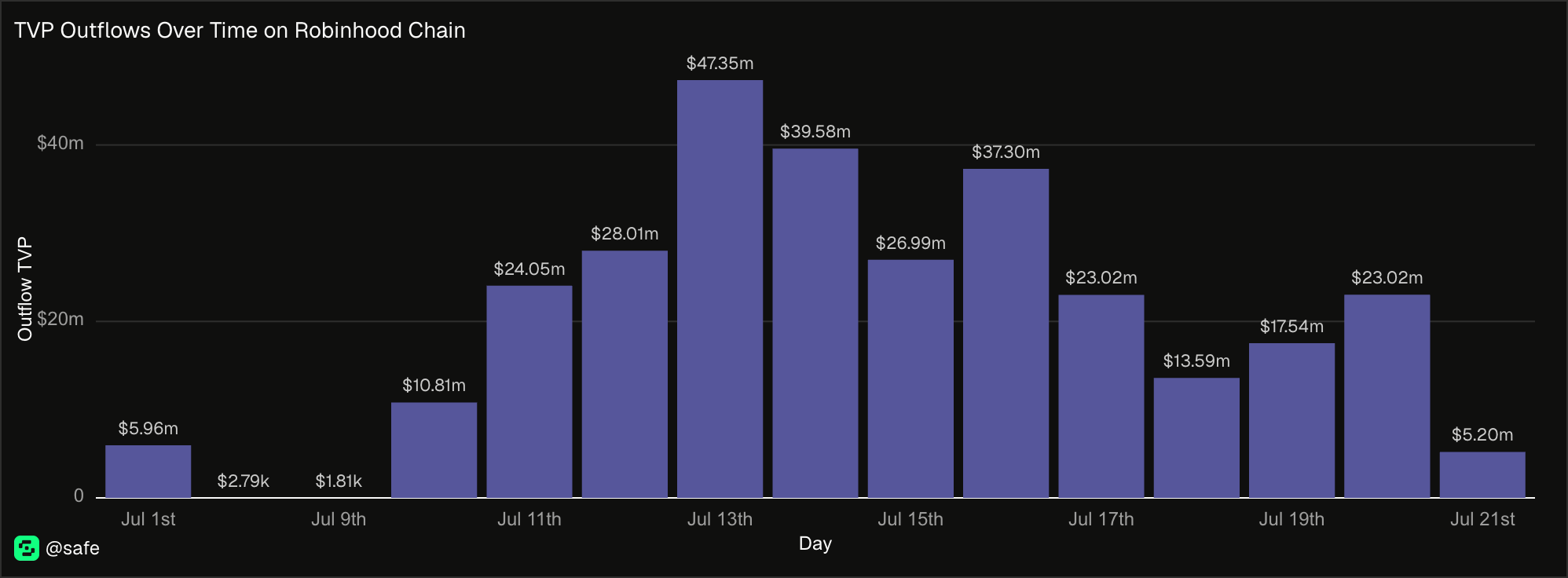 Outflow volume via Safe smart accounts on Robinhood Chain grew from $5.96m on 1 July 2026 to $47.35m by 13 July, tens of millions moving through Safe-secured accounts within 2 weeks of mainnet launch.
Protocols wanted Safe on Robinhood Chain before the chain itself went public. That's what a trust signal looks like.
Here's why, in their own words:
Steakhouse sets the parameters other people's deposits run under, so its curator account can't hang on a single key:
"Steakhouse's job is to curate risk profiles for depositors, but security risk is never acceptable. The curator account sets a vault's parameters, so it runs on a Safe multisig: a threshold of signers, and no single key that can act alone."
Sébastien Derivaux, Steakhouse Financial
Maple treats token ownership and cross-chain settings as high-privilege controls, so on Robinhood Chain they run on a multisig:
Ownership of our token contract on Robinhood Chain sits in a Safe multisig, so privileged actions like CCIP configuration and bridge rate limits require multiple signers - designed so no single signer can act alone. It's the same standard we apply to every chain we deploy, which is why having Safe live before mainnet mattered to us."
Chuck Paiusi, Product, Maple
Where the largest treasuries already sit
Some of the largest treasuries in crypto already run on Safe. Their capital doesn't move to chains where Safe doesn't.
The Ethereum Foundation moved its entire treasury – more than 160,000 ETH, worth roughly $650M at the time – into Safe{Wallet} in October 2025. In April 2026, it sold 10,000 ETH (roughly $23M) OTC to BitMine, executed straight from its disclosed Safe multisig, visible to anyone on a block explorer.
Vitalik keeps more than 90% of his personal holdings in Safe.
For a chain founder, the takeaway is practical: most investors, LPs, and whales you want on your network already custody their portfolios in Safe. Without Safe on your chain, that capital has fewer places it can go.
Conclusion
Robinhood Chain shipped Safe before its mainnet went public. It launched with protocols, users, and liquidity already committed.
Every week your chain runs without Safe is a week of protocols spent building somewhere else.
Deploy Safe first. The finance you want to bootstrap arrives with it.
FAQ
Does Maple use Safe?
Yes. Maple deployed its Safe multisig on Robinhood Chain before the network's public launch.
Does Vitalik Buterin use Safe?
Yes. Vitalik said publicly that he keeps more than 90% of his personal holdings in a Safe multisig.
Does the Ethereum Foundation use Safe?
Yes. The EF moved its entire treasury, more than 160,000 ETH, into Safe{Wallet} in October 2025.
Is Safe deployed on Robinhood Chain?
Yes. Safe{Wallet} was a day one launch partner for Robinhood Chain.
This article was written by Aniket Bhardwaj and edited by Julia Deufel.
Aniket Bhardwaj at Safe{Labs} • 27 July 2026