What is a multisig wallet
Learn what a multisig wallet is, how it works, and why it matters. Understand key differences, trade-offs, and real-world applications, with real examples from Safe.
Safe {Labs} • 28 May 2026
)
Multisig Wallet Basics – TLDR
A multisig (multisignature) wallet is a crypto wallet that requires multiple private keys to approve a transaction instead of just one. It works by defining a rule, such as 2-of-3 approvals, meaning two out of three authorized signers must approve before funds move. This matters because it removes single points of failure, improves coordination, and introduces structured control over onchain assets.
Multisig: Definition And Positioning
A multisig wallet is a system in which transaction authorization is shared among multiple parties or devices. Each participant holds a private key, and transactions only execute when a predefined number of signatures is collected.
This differs from traditional wallets, where one private key controls all assets. In that model, losing or compromising the key results in total loss of control.
Multisig is not:
A custodial service managing funds on your behalf
A recovery tool for lost keys
A guarantee against all risks
It is a coordination mechanism for transaction approval.
Within the broader crypto ecosystem, multisig sits between:
Single-key wallets (EOAs) — simple but fragile
Smart accounts — programmable accounts with extended logic
Safe is one of the most widely deployed multisig systems, and its architecture reflects this: at its core, Safe is a smart contract wallet in which transaction authorization is shared among multiple signers, with the contract itself enforcing the approval rules onchain.
Multisig is often the first step toward structured onchain operations. It introduces shared control without requiring fully programmable account systems.
How Multisig Wallets Work (Core Mechanics)
At a basic level, multisig wallets operate through shared authorization rules.
Step 1: Define Participants And Threshold
A multisig wallet is created with:
A set of participants (N signers)
A threshold (M approvals required)
Example: A 2-of-3 multisig requires any two of three signers to approve a transaction.
Step 2: Propose A Transaction
One signer initiates a transaction:
Sending crypto
Interacting with a smart contract
Executing a protocol action
The transaction is not executed immediately.
Step 3: Collect Signatures
Other authorized signers review the transaction and approve it using their private keys.
Each approval:
Verifies intent
Adds a cryptographic signature
Moves the transaction closer to execution
Step 4: Execute The Transaction
Once the required number of approvals is reached:
The transaction is executed onchain
Funds or actions are finalized
With Safe, this entire flow, from proposal and signature collection to execution, happens within the Safe smart contract, with no trusted third party involved at any stage.
Example Of A Multisig Transaction
A startup manages treasury funds using a 2-of-3 multisig:
Founder A proposes sending funds to a vendor
Founder B reviews and approves
The system now has 2 approvals
The transaction executes automatically
Founder C is not required in this case, but still retains participation rights.
Possible Risks
If too many keys are lost, funds become inaccessible
If coordination fails, transactions may stall
If signers are compromised, approvals can be abused
Multisig reduces single-point risk but introduces coordination dependencies.
Deep Dive on Multisig Wallets
Multisig is often understood as “more signatures equals more security.” The reality is more nuanced.
Threshold Design Trade-Offs
The choice of M-of-N affects both security and usability:
Lower threshold (e.g., 2-of-3)
Faster execution
Lower coordination friction
Higher risk if keys are compromised
Higher threshold (e.g., 4-of-5)
Stronger security guarantees
Slower decision-making
Increased operational overhead
Choosing a multisig setup is an organizational design choice as well as a security decision.
Safe is built on this principle. Its smart contract architecture uses multisig as the approval foundation, then extends it — modules can enforce spending policies, automate recurring transactions, or integrate directly with protocols, all without removing the core signing requirement.
Key Distribution Matters
Security depends on where and how keys are stored:
Hardware wallets reduce exposure to online threats
Geographic distribution reduces correlated risk
Role-based key ownership improves accountability
Poor key distribution can undermine multisig entirely.
Multisig And Smart Accounts
Traditional multisig implementations operate as contract-based wallets. Modern systems extend this into smart account infrastructure, where multisig becomes one module within a programmable system.
This enables:
Policy-based approvals
Automated execution rules
Integration with protocols and services
Multisig evolves from a static approval mechanism into a coordination layer for onchain execution.
Scaling Multisig Operations
At a small scale, multisig is manageable manually. At a larger scale, complexity increases:
More transactions
More participants
More chains
Teams begin to require:
Transaction simulation
Role separation
Audit trails
Execution policies
Multisig becomes part of a broader operational system, not just a wallet.
Real-World Use Cases Of Multisig
Multisig becomes necessary when control must be shared or risk must be distributed.
Institutions
Funds and trading firms use multisig to enforce:
Approval workflows
Internal controls
Compliance requirements
Multisig introduces accountability into transaction execution.
Teams And Startups
Crypto-native teams use multisig for:
Treasury management
Vendor payments
Protocol operations
Without multisig, one compromised key could drain the entire treasury.
DAOs
Decentralized organizations rely on multisig for:
Governance execution
Fund allocation
Emergency actions
Multisig acts as an execution layer for governance decisions.
Individuals
High-value holders use multisig to:
Split keys across devices
Reduce risk of single-device compromise
Common Misconceptions
Misconception: Multisig Is Only For Large Organizations
Why people believe it: It sounds complex and operationally heavy.Reality: Individuals benefit from multisig for high-value holdings.Why it matters: Security risks exist at all scales.
Misconception: One Private Key Is Enough If Stored Safely
Why people believe it: Hardware wallets are considered secure.Reality: Single-key systems still create a single point of failure.Why it matters: Multisig distributes risk instead of concentrating it.
Misconception: Multisig Eliminates All Risk
Why people believe it: Multiple approvals feel inherently safer.Reality: Poor coordination or key management introduces new risks.Why it matters: Multisig reduces risk; it does not remove it.
Misconception: All Wallets Offer The Same Control
Why people believe it: Wallets are often compared by interfaceReality: Wallet architecture defines how transactions are executedWhy it matters: Control is determined at the protocol level, not the UI.
Multisig Vs Single-Signature Wallets
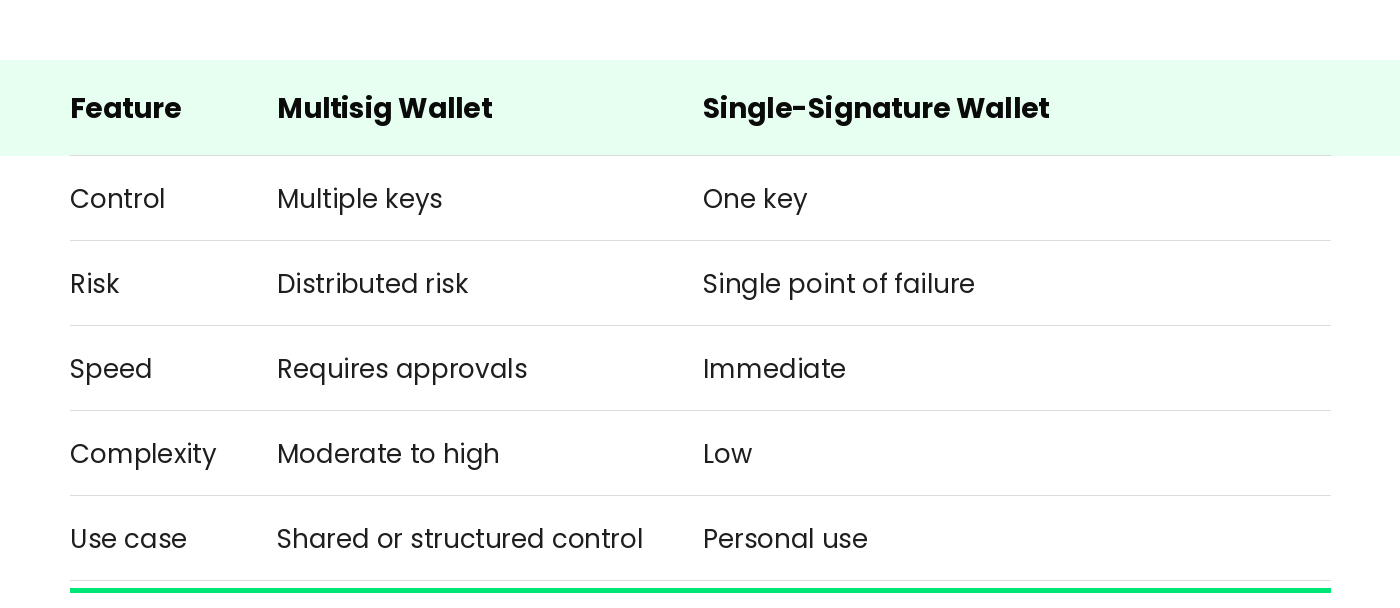 Single-signature wallets prioritize simplicity.Multisig prioritizes security and coordination.
Popular Multisig Wallets
Several implementations exist across the ecosystem:
Safe (Ethereum and EVM-compatible chains)
Squads (Solana)
Casa.io (Bitcoin)
These systems differ in architecture, flexibility, and operational capabilities. Some focus purely on multisig, while others, such as Safe, extend into programmable account systems.
How Safe Fits Into This
Safe applies multisig within a broader smart account architecture.
It enables:
Multisig approvals as a base layer
Transaction simulation before execution
Modular extensions for policy and automation
Multi-chain treasury coordination
Safe is widely used by protocols, funds, and teams because it turns multisig from a basic security feature into a coordination system for onchain operations.
Conclusion
Multisig changes how control works in crypto. It replaces individual authority with structured approval systems.
This shift matters as assets, teams, and protocols scale. Security is no longer just about protecting a key. It becomes about designing how transactions are authorized and executed.
The threshold you choose, how keys are distributed, and how approvals are structured are the decisions that determine whether multisig works at scale.
FAQs
What is a multisig wallet in simple terms?
A multisig wallet requires multiple people or devices to approve a transaction before it executes. It works like a joint bank account with a rule: a transaction goes through only if enough co-signers approve it. Instead of one person holding one key, control is split, and nothing moves until the required number of keyholders agree.
How does a multisig wallet work?
A transaction is proposed, signed by multiple authorized parties, and executed once the required number of approvals is reached.
Why is multisig important?
It removes single points of failure and introduces shared control over digital assets.
Is multisig better than a single-signature wallet?
It depends on the use case. Multisig offers stronger security and coordination, while single-key wallets are simpler and faster.
When should I use a multisig wallet?
Use multisig when:
Managing shared funds
Holding significant value
Requiring approval workflows
What are the risks of multisig?
Risks include:
Key loss leading to locked funds
Coordination delays
Misconfigured approval thresholds
Safe {Labs} • 28 May 2026