MPC Wallet vs Multisig: What’s the Difference?
MPC wallets vs multisig wallets: MPC wallets split a single private key into cryptographic shares and sign transactions offchain, while multisig wallets use multiple independent keys and require onchain approval through smart contracts.
Safe{Labs} • 28 May 2026
)
MPC wallets vs multisig wallets: MPC wallets split a single private key into cryptographic shares and sign transactions offchain, while multisig wallets use multiple independent keys and require onchain approval through smart contracts.
Choosing between an MPC wallet and a multisig wallet is a core decision when designing crypto custody solutions, especially for institutions, protocols, and teams that manage assets onchain.
Both models remove single key risk. They differ in how coordination is enforced and how trust is distributed.
What is an MPC wallet vs multisig?
An MPC wallet distributes signing authority across shares of a single key using threshold signature schemes. A multisig wallet requires approvals from multiple independent keys enforced through smart contract wallets.
MPC coordinates signing offchain and submits one signature; multisig verifies approvals directly onchain. These differences shape governance, cost, and operational design.
Quick summary
MPC wallets coordinate signing offchain and submit a single aggregated signature.
Multisig wallets enforce approval thresholds onchain through smart contract logic.
MPC reduces onchain cost and latency.
Multisig provides deterministic, auditable execution.
Both are core components of modern institutional wallet infrastructure.
What Is a Multisig Wallet?
A multisig wallet requires multiple independent private keys to approve a transaction, defined by an M-of-N threshold such as 2-of-3.
Each signer controls a separate key. Transactions execute only when the required number of approvals is reached.
Multisig wallets operate as smart contract wallets, where execution rules are enforced onchain rather than by a single signer.
Simple analogy
A multisig wallet is like a vault with multiple locks. Each participant holds a different key, and the vault opens only when enough keys are used together.
Real-world example: Safe {Wallet}
Safe{Wallet} is smart account infrastructure that enforces multisig approval logic directly onchain. It is used by protocols, funds, and organizations to coordinate treasury management, execute transactions, and enforce policy at the account level.
Safe secures over $60B in digital assets and supports production-grade onchain operations across 25+ networks.
Key benefits
Multiple signers share control – no single point of failure
Transparent approvals and governance
Onchain verification and auditability
Programmable execution through modules, policies, and transaction simulation
Limitations
Threshold updates require explicit onchain execution.
Higher execution cost per transaction.
Approval flows require coordination across signers.
What Is an MPC Wallet?
An MPC (multi-party computation) wallet distributes a private key into multiple cryptographic shares.
No participant holds the full key. Signing happens collaboratively, and the final result is submitted as a single signature.
Simple analogy
An MPC wallet is like splitting a key into fragments. Each fragment is useless on its own, but together they can authorize a transaction without reconstructing the full key.
Real-world examples
Fireblocks
Coinbase Custody
These systems are widely used in crypto custody solutions where execution speed and cross-chain coordination are required.
Key benefits
Distributed key shares enable signing without reconstructing a private key
Faster execution with minimal onchain overhead
Private transaction coordination
Limitations
Complex cryptographic systems
Reduced transparency compared to onchain models
Often dependent on infrastructure providers
MPC vs Multisig – Key Differences
The difference between MPC and multisig wallets comes down to execution model, cost, and trust assumptions.
The table below compares MPC wallets and multisig wallets across key dimensions such as execution model, cost, and trust assumptions:
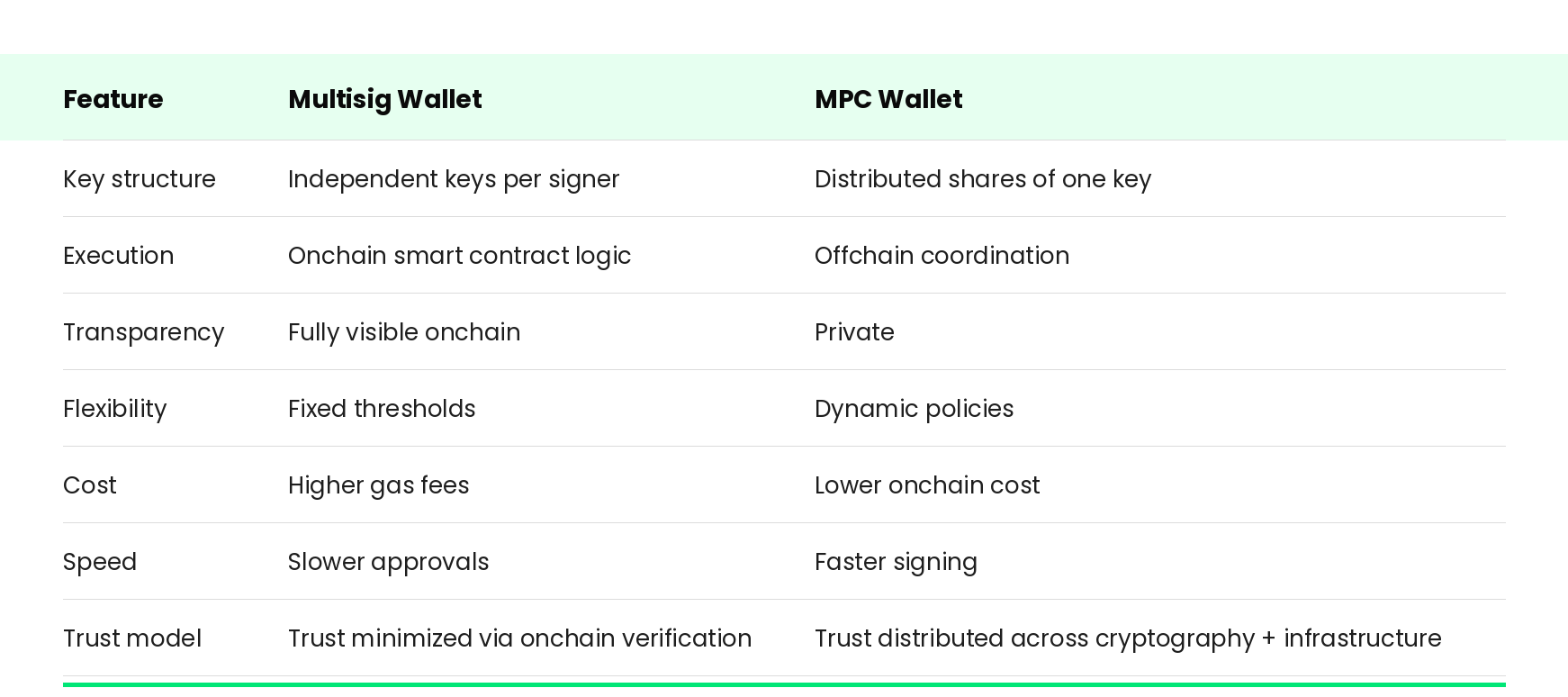
MPC vs Multisig Trust Model
The most important difference between MPC and multisig wallets is how trust is structured.
Multisig trust model
Multisig minimizes trust by enforcing rules directly onchain.
Approval logic is visible and verifiable
Execution is deterministic
No dependency on external systems
Trust is placed in smart contract code and signer independence. "Don't trust, verify" is built in: Safe contracts are verifiable on-chain, and trust is placed in code and signer independence — not in any individual or institution.
MPC trust model
MPC distributes trust across cryptography and infrastructure.
Security depends on threshold signature schemes.
Signing coordination often happens offchain.
Infrastructure providers may play a role in execution.
Trust is shared between protocol design and operational setup.
Key takeaway: Multisig eliminates trust through on-chain verification — every Safe contract is verifiable on-chain. MPC distributes trust across systems and participants.
MPC vs Multisig Security: Which Is Safer?
Security depends on whether the risk is concentrated in key compromise or in the systems coordinating it.
Multisig security model
A single key compromise cannot authorize a transaction. An attacker must compromise multiple independent signers to take control.
Every transaction is fully auditable on-chain
No reliance on external infrastructure or coordination
"Don't trust, verify" is a design property, not a claim
Risks:
Signer collusion
Key loss without recovery
Misconfigured thresholds
MPC security model
A single share compromise cannot reconstruct the private key — an attacker must compromise multiple shares across separate systems to sign
Uses distributed computation across parties or devices, with no single point of failure
Risks:
Implementation vulnerabilities
Provider compromise or downtime
Reduced transparency
Conclusion:
Multisig externalizes trust into verifiable code. MPC internalizes trust into systems and infrastructure that cannot be fully verified on-chain.
For teams that require auditability, regulatory accountability, or self-sovereignty, multisig is the stronger security model. MPC trades some of that transparency for operational convenience.
Pros and Cons of MPC vs Multisig Wallets
MPC Wallet Pros
Faster execution
Lower onchain cost
Flexible governance policies
Improved privacy
MPC Wallet Cons
Complex systems
Provider dependency
Limited transparency
Multisig Wallet Pros
Fully transparent and verifiable onchain
Enforced through smart accounts, removing reliance on offchain coordination or trust
Built for coordinated execution across teams and protocols for governance and treasury coordination
Native to account abstraction systems and programmable execution flows
Multisig Wallet Cons
Operational overhead without automation
Higher gas costs due to more complex transactions
Flexibility depends on configuration
Use Cases – When to Use Each
Choose MPC if:
You operate trading or execution systems
You need fast, automated transaction flows
You manage assets across multiple chains
You prioritize efficiency within institutional wallet infrastructure
Choose multisig if:
You manage protocol or DAO treasuries
You require transparent governance
You coordinate decisions across stakeholders
You need verifiable onchain execution
Multisig functions as the coordination layer for onchain systems, where execution rules, approvals, and policy are enforced at the account level. MPC functions as a signing layer optimized for execution throughput and operational efficiency.
Which Is Better for Crypto Custody?
The better option depends on how your system operates.
Choose MPC if:
Speed and automation are primary requirements
You operate high-frequency or cross-chain systems
You prioritize operational flexibility
Choose multisig if:
Transparency and governance are critical
You manage shared treasuries or protocol operations
You require deterministic execution
Trade-off summary:
MPC = efficiency and flexibility
Multisig = transparency and control
Many modern crypto custody solutions combine both approaches across different layers.
Risks and Attack Scenarios
Understanding failure modes is critical.
Multisig risks
Centralized signer distribution
Social engineering attacks
Poor threshold configuration
MPC risks
Compromised infrastructure
Hidden implementation flaws
Vendor lock-in
Risk is redistributed, not removed.
Final Thoughts
MPC and multisig wallets represent two distinct approaches to securing digital assets.
Multisig aligns with transparent, verifiable onchain coordination.MPC aligns with flexible, high-speed execution across systems.
Most production-grade custody systems today combine both MPC and multisig wallets to best serve their needs.
Frequently Asked Questions
Is an MPC wallet safer than a multisig wallet?
Neither is inherently safer. Multisig offers stronger transparency and onchain enforcement, while MPC provides flexibility and reduces single key exposure. Security depends on implementation and threat model.
Do institutions use MPC or multisig wallets?
Institutions typically use both MPC and multisig wallets, depending on the function within their custody architecture.
Many production custody systems separate concerns:
MPC handles transaction execution and automation
Multisig enforces governance, approvals, and policy
This creates a layered architecture where execution speed and control guarantees are handled independently.
MPC wallets are commonly used for execution layers, where speed, automation, and cross-chain transaction management are required. This makes them well-suited for exchanges, trading firms, and payment infrastructure.
Multisig wallets are used for governance and treasury management, where transparency, auditability, and stakeholder coordination are critical. They are commonly used by protocols, DAOs, and funds to manage shared assets.
In many production systems, MPC handles transaction execution, while multisig enforces governance and approval workflows.
Can MPC replace multisig wallets?
MPC can replace multisig in execution-heavy environments, but multisig remains the standard for governance and treasury coordination.
What are the risks of MPC wallets?
MPC wallets introduce risks related to implementation complexity, infrastructure dependency, and reduced auditability compared to onchain systems.
Which is cheaper: MPC or multisig?
MPC wallets are typically cheaper onchain because they produce a single signature. Multisig requires multiple signatures, increasing transaction costs.
What is the difference between MPC and multisig wallets?
MPC distributes signing authority across key shares and coordinates offchain, while multisig requires approvals from multiple independent keys and enforces execution onchain.
Safe{Labs} • 28 May 2026